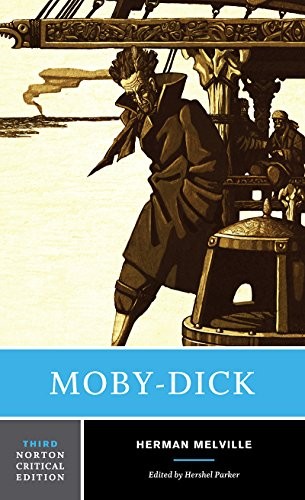
“One of the great strengths of this third edition is Hershel Parker’s inclusion of commentary on Moby-Dick from its publication in 1851 right into the 21st century to answer why Moby-Dick—boisterous, beautiful, filled with soaring language, forever questioning, and nearly 200 years old—is more popular than ever.” —MARY K. BERCAW EDWARDS, University of Connecticut
This Norton Critical Edition includes: • Melville’s classic novel of whaling and revenge, based on Hershel Parker’s revision of the 1967 text edited by Harrison Hayford and Hershel Parker. • Twenty-six illustrations, including maps, contemporary …
“One of the great strengths of this third edition is Hershel Parker’s inclusion of commentary on Moby-Dick from its publication in 1851 right into the 21st century to answer why Moby-Dick—boisterous, beautiful, filled with soaring language, forever questioning, and nearly 200 years old—is more popular than ever.” —MARY K. BERCAW EDWARDS, University of Connecticut
This Norton Critical Edition includes:
• Melville’s classic novel of whaling and revenge, based on Hershel Parker’s revision of the 1967 text edited by Harrison Hayford and Hershel Parker.
• Twenty-six illustrations, including maps, contemporary engravings, and diagrams of whaleboat rigging.
• Background and source materials centering on whaling and whalecraft, Melville’s international reception, the inspirations for Moby-Dick, and Melville’s related correspondence.
• Forty-four reviews and interpretations of the novel spanning three centuries.
• A revised and updated Selected Bibliography.
So thoroughly about whales and whaling and the pre-fossil-oil industry that trying to write a book about any of that without reference to this now feels impossible. Thankfully, I'm not writing a book of whale facts; its been done.
"Blood for Oil!" (p291) This story echoes Don Quixote's wandering and precarity, but connects more immediately to the modern world's thirst for exploitation. Seriously relevant.
Technical knowledge's belief it has overcome passions and the most inevitable, which gives justification for the huge bulk of whale and whaling facts, while also constantly and purposefully undercutting the worth of reading all that.
I read this over the course of about 6 months as a group read. 5-10 of us would meet for an hour a week and take turns reading chapters. It's a very enjoyable experience that way, and at the same time I don't think I'd even have finished the book if I'd tried to read it alone.
Apart from being notoriously long, it's full of meandering digressions many of which would probably have lost me. And the tone of the writing is dominated by the pomposity of the narrator, which at times is used for great effect but at others just grates. It's also extremely wordily heavy. I realise that some of this is just the literary English of the time, but Melville was well capable of using that style to dramatic effect, like in Bartleby which I found a total page-turner, or some of my favourite individual chapters …
I read this over the course of about 6 months as a group read. 5-10 of us would meet for an hour a week and take turns reading chapters. It's a very enjoyable experience that way, and at the same time I don't think I'd even have finished the book if I'd tried to read it alone.
Apart from being notoriously long, it's full of meandering digressions many of which would probably have lost me. And the tone of the writing is dominated by the pomposity of the narrator, which at times is used for great effect but at others just grates. It's also extremely wordily heavy. I realise that some of this is just the literary English of the time, but Melville was well capable of using that style to dramatic effect, like in Bartleby which I found a total page-turner, or some of my favourite individual chapters of Moby-Dick which would have been great stand-alone novellas. And while I suspect it was racially progressive for a novel written by a white USian back then, from any other perspective it's infuriatingly racist.
So why still a classic? Well, it does manage to conjure up a world, in which it tells a story that's simultaneously very small (one boat hunting one whale) and huge (an epic journey for that crew; a microcosm of whaling as a whole), with some very vividly rendered characters along the way, and much more comedy than I expected from the way people talk about this book.